
Standby drain: how to measure what drains your motorcycle battery when it is off

You switch the bike off, take the key out and forget about it. But the battery never fully rests: some circuits keep drawing current with everything off. This is called standby drain (or parasitic drain). It is almost always small and normal. But when it grows, the battery empties in a few days. Here is how to measure it yourself and how to find the culprit.
What draws current with the bike off
- The ECU memory and the dashboard clock.
- The alarm or immobiliser.
- A GPS tracker.
- Accessories wired straight to the battery: USB chargers, heated grips or lights with poor wiring.
- A faulty component, such as a leaking regulator or a relay that sticks closed.
How long the battery takes to go flat
It is easy to work out. Battery capacity is given in amp hours (Ah); you will measure the drain in milliamps (mA). As a rough guide, a motorcycle battery can struggle to start the engine once it has lost around half its charge.
Example: a 10 Ah (10,000 mAh) battery with a standby drain of 10 mA loses half its charge in about 500 hours, or roughly three weeks. At 30 mA, in barely a week. On top of that comes the battery's own self-discharge, which is higher when it is warm.
How to measure standby drain
You need a multimeter that measures DC current (A with the straight line), ideally with a mA range.
- Prepare the bike. Key out, everything off and the battery charged.
- Set the multimeter to measure current. Put the red lead in the high-current socket (10 A or 20 A) and the selector on DC current. Starting on the high range protects the multimeter's fuse.
- Disconnect the negative terminal of the battery.
- Connect the multimeter in series: one probe on the battery's negative terminal and the other on the negative cable you have just removed. Now all the bike's current flows through the multimeter.
- Wait. Many bikes have modules that take a few minutes to “go to sleep” after power is disconnected and restored. Wait until the reading settles; on some modern bikes it can take quite a bit longer.
- Read the value. If it is very low, switch to the mA range (moving the red lead to its socket) for more precision.
Important: with the multimeter connected in series, do not switch on the ignition or press the starter. The starter motor draws a huge current and will blow the multimeter's fuse, or worse.
If your bike has a factory alarm or a radio code, check the manual before disconnecting the battery: some require a procedure when reconnecting.
What values are normal
- Bike without accessories: a few milliamps.
- With an alarm or tracker: 10–20 mA is common.
- More than 20–30 mA with everything off: something is drawing too much and is worth tracking down.
Values are a guide only. Every bike is different: your model's workshop manual may state the acceptable standby drain.
How to find the circuit to blame
- With the multimeter still connected in series, open the fuse box.
- Remove the fuses one at a time, watching the reading each time.
- When removing one makes the drain drop sharply, you know which circuit it is: the fuse box diagram or the manual tells you what it powers.
- Put each fuse back before moving on to the next one.
- If the drain does not drop with any fuse, suspect something wired straight to the battery: an accessory, the regulator or added wiring.
And when the drain is normal but the bike sits for weeks
Sometimes there is no fault at all: the bike simply has an alarm, tracker or ECU, and goes unused for a long time. In that case you have two options. If you have a socket nearby, a battery maintainer. If not, cut the battery.
The W89 battery disconnector cuts the battery with a button and, once cut, draws nothing. Cutting it switches everything off, including the alarm and the clock, so it makes sense to use it when the bike will sit for a few days. If you want to compare all the options, we explain them in how to stop your motorcycle battery from draining.
Choose your version
W89 B01 battery disconnector: both buttons sit in a handlebar mount.
W89 B02 battery disconnector: loose buttons, to mount wherever you like.
See the B01 → See the B02 →Frequently asked questions
Can I measure the drain with a clamp meter?
Only if it measures DC current and is accurate in the milliamp range. Many cheap clamp meters are not that precise; for such small currents, a multimeter in series is more reliable.
What if the battery goes flat even though the drain is low?
The battery may no longer hold a charge, or the charging system may not be filling it while you ride. We explain how to check in how to tell if your motorcycle regulator is failing.
Questions about your bike? Write to us and we will help.
W89 Technologies · Vigo

Motorcycle Battery Disconnect Switch W89 B01 · Handlebar Mount
Cut your motorcycle battery from the handlebar and stop finding it flat. When you park the bike, press the red button and...
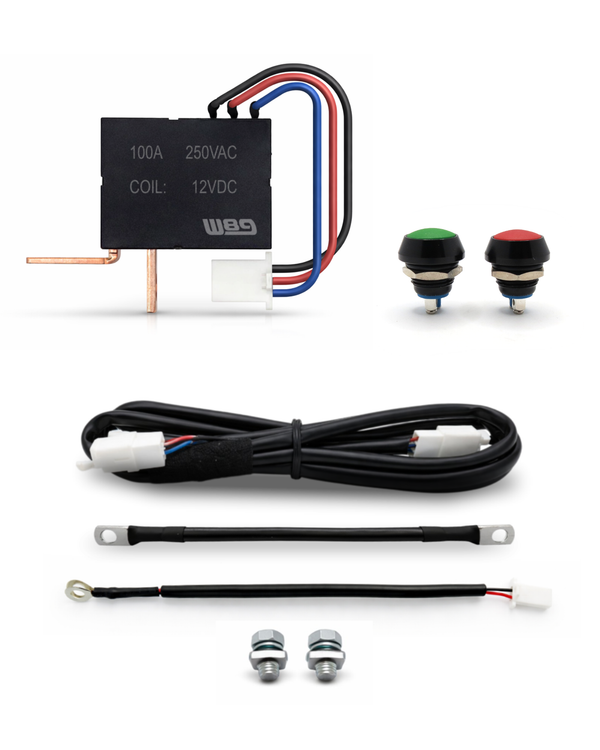
Motorcycle Battery Disconnect Switch W89 B02 · Separate Buttons
Cut your motorcycle battery with two buttons you fit wherever you like. Under the seat, on the frame, next to the battery...